
Movie School Free » Film Editing Course » Sound Design for Film Course » Choosing Music for a Film
How to Choose Music for a Film: Process, Creative Choices, and Licensing (With Examples)
Choosing music for a film means selecting the songs, score, and sound that support a scene’s emotion, rhythm, and meaning, and making sure you have the legal right to use them. Good film music serves the story first: it tells the audience something about the scene instead of just filling the silence.
This guide explains how to choose music for a film step by step: what music does in a scene, the different types of film music, a practical selection process, the creative choices that matter, and the licensing basics every filmmaker should know before the final mix.
Table of Contents
What Music Does in a Film
Before you choose any film music, it helps to know what music can actually do. Music is never just background. It is one of the most powerful storytelling tools a filmmaker has, because it speaks directly to the audience’s feelings without a single line of dialogue.
Music in a film can:
- Carry emotion. It can tell the audience how to feel about a moment, or what a character feels but cannot say.
- Set tone and genre. A few notes are often enough to signal a thriller, a comedy, or a romance.
- Build tension and release it. Rising or repeating music creates suspense, and its sudden end creates relief or shock.
- Establish time and place. A song or instrument can place a scene in a decade, a culture, or a location.
- Add information the image does not give. Music can hint that something is wrong, reveal what a character is thinking, or comment on the action.
- Shape rhythm. Music affects how fast or slow a scene feels, and it can link the cuts in an edit.
Some music leads, driving the scene’s emotion. Some music supports, quietly adding to what is already there. Both are valid. The mistake is to add music without knowing which job it is doing.
Ask What the Scene Needs First
The most important rule in choosing music for a film is the order of the questions. Start with what the scene needs, not with what music you like. Ask what the audience should feel, what the scene is missing, and whether music is the right tool at all. Sometimes the answer is no music, only silence or natural sound. Only when you know what the scene needs does it make sense to look for the music that provides it.
Types of Music in Film
Film music comes from several sources, and each one has a different cost, creative effect, and legal requirement. The table below compares the main types.
| Type | What It Is | How You Get It | Relative Cost | Advantage | Main Risk |
|---|---|---|---|---|---|
| Original Score | Music composed specifically for your film. | Hire a composer. | Medium to high | Fits your film exactly; you can shape it. | Needs time, budget, and clear communication. |
| Needle Drop | An existing song placed in a scene. | License the song. | Low to very high | Instant emotional and cultural associations. | Rights can be expensive or refused. |
| Library / Stock Music | Pre-recorded tracks from a catalog. | License from a music library. | Low | Fast and affordable. | Can sound generic; others may use the same track. |
| Source Music | Music that exists in the scene, such as a radio or a band. | Original, licensed, or library. | Varies | Adds realism and place. | Must feel natural in the world of the scene. |
| Temp Music | Placeholder music used while editing. | Any existing music. | Free for editing only | Helps the edit and shows what you want. | Not cleared for release; can become hard to replace. |
Film Score vs. Soundtrack
People often use these words interchangeably, but they mean different things. A film score is the original instrumental music composed for a film. A soundtrack usually means the collection of music released with the film, which can include the score, licensed songs, or both. In everyday use, “soundtrack” can also mean all the music heard in a film.
Diegetic vs. Non-Diegetic Music
Diegetic music comes from inside the world of the story, so the characters can hear it too: a radio, a band at a party, a character singing. Non-diegetic music exists only for the audience, like most film scores. The two can also blur. A song that starts on a radio and becomes the film’s score has moved from one to the other, and this is a technique filmmakers use deliberately.
What Is a Needle Drop?
A needle drop is the use of an existing, often well-known song in a scene. The name comes from placing a record needle on a record. Needle drops bring strong associations with them, which can be a creative advantage or a risk, depending on how the audience already feels about the song.
How to Choose Music for a Film: Step by Step
Choosing music is a process, not a single decision. Whether you are working on a short film or a feature, these seven steps will help you make better choices and avoid expensive surprises later.
- Understand the story and the tone. Decide what the film as a whole should make the audience feel. Write it in a sentence, such as “quiet and lonely, with moments of warmth.” This sentence will guide every music decision.
- Hold a spotting session. Watch the film with the director, the editor, and the composer or music supervisor if you have them. Decide where music begins, where it ends, and, just as importantly, where there should be none. Take notes scene by scene.
- Define what each scene needs. For every spot, write down the emotion, the pace, whether the music should be inside the scene (diegetic) or only for the audience, and whether lyrics would help or distract.
- Use temp music as a reference. Place existing music in the edit as a placeholder to test ideas. Treat it as a tool, not a decision.
- Search and select. Brief a composer, browse licensed catalogs, or approach artists for songs. Collect several options for each scene instead of committing to one.
- Test the music in the edit. Play it with the picture, the dialogue, and the sound effects. Does it help the scene, or just decorate it? Does it still work at the final volume?
- Clear the rights and finalize. Confirm every license, get agreements in writing, and keep the paperwork. Do this before you lock the cut, not after.
Choosing film music: seven steps, with a loop back to what the scene needs
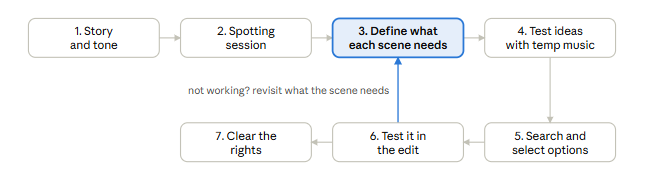
If a cue does not work in the edit, go back to what the scene needs before you try another track.
What Is a Temp Track?
A temp track is existing music placed temporarily in an edit to show the intended mood, rhythm, and style while the film is being cut. It guides the editor, and later the composer, but is normally not cleared for release and must be replaced or licensed before the film is shown publicly.
Temp tracks are useful, but they come with a known danger called temp love. After watching a scene dozens of times with the same music, the filmmaker can no longer imagine it any other way, which makes it hard for a composer to offer something different, or for the budget to allow the original song. To avoid it, try more than one temp option, and keep asking what the scene needs, not what it currently has.
What Is a Spotting Session?
A spotting session is a meeting in which the filmmakers watch the film and decide where music should start and stop, what it should do in each place, and what style it should have. It is the point at which music moves from a vague idea to a plan. A good spotting session leaves everyone with the same list of cues, the same goals for each, and a shared understanding of where silence is the right choice.
Creative Choices: What to Look For
Once you know what a scene needs, these are the practical creative decisions that shape how well your film music works.
Reinforce the Emotion, or Add a Layer
Music can strengthen what the image already shows, or it can add something the image does not. Sad music over a sad scene reinforces it. Warm, gentle music over a character who is about to leave adds a layer of longing. Ask which one your scene needs, and avoid using music only to repeat what the audience already feels.
Consider Counterpoint
Music that contrasts with the image, such as cheerful music during a violent moment, can create irony and unease. This technique, called counterpoint, works when the contrast has a purpose. Used without a reason, it can feel like a trick.
Pay Attention to Timing
When music starts and stops matters as much as what it is. Entering late on an emotional beat can feel earned. Ending abruptly can create shock. And silence is a choice too: removing music at the most intense moment can make it hit harder than any score could.
Match Rhythm to the Edit
The tempo of the music affects how fast the scene feels. Music that works with the pace of the cuts can make an edit feel smooth, while music that fights it creates tension or confusion. Test it by watching the scene with the music at full volume.
Think Carefully About Lyrics
Songs with lyrics bring their own story. They can add meaning, but they can also compete with dialogue or explain too much. If characters are speaking, instrumental music or very sparse vocals usually leave more room.
Familiar or Unfamiliar?
A well-known song brings associations that the audience already has, which can add meaning instantly or work against you if the audience connects it to something else. Unfamiliar music lets viewers experience the scene without those associations. Neither is better, but the choice should be deliberate.
Use a Recurring Theme Sparingly
A leitmotif is a short musical idea tied to a character, place, or concept. When it returns, the audience remembers what it stands for. It is a powerful tool, but it loses its effect if it appears in every scene.
Music, Dialogue, and Sound
Film music does not exist on its own. It shares the soundtrack with dialogue, sound effects, and ambience, and the three must fit together. Music that sounds great alone can bury a line of dialogue in the final mix, so choose music that leaves space for the voice: sparser arrangements, instruments that do not compete with the human voice, and cues that drop in level or pause when characters speak. Check every cue against the dialogue early, not only at the final mix. For more on how the elements of the soundtrack work together, see our guide to ADR and sound.
Music Licensing for Film
Music licensing for film is where many independent filmmakers get stuck. Choosing a great song is easy. Being allowed to use it is the hard part. Music is protected by copyright, so you need permission before you put it in a film that will be shown outside your own edit room.
This section gives general information, not legal advice. Rules and fees vary by country and by project, so check the terms of every license, and consider a music supervisor or an entertainment lawyer for any film you plan to release.
Sync License vs. Master Use License
When you use an existing, commercially released song, there are usually two separate rights to clear:
- Sync license (synchronization license): permission to use the musical composition, meaning the song as written, with moving images. It is usually granted by the songwriter or the music publisher.
- Master use license: permission to use a specific recording of that song. It is usually granted by the record label or whoever owns the recording.
If you want the original recording of a famous song, you typically need both. If you record your own version of a song, you only need the sync license for the composition, since you own your recording.
Original Music
When you hire a composer, the agreement should state clearly who owns the music, how you may use it (which media, territories, and time period), what the fee is, and how the composer will be credited. Many film composers work under a work-for-hire arrangement, in which the film’s producer owns the music, but terms differ, and everything should be in writing before work begins.
Royalty-Free Does Not Mean Free
“Royalty-free” usually means you pay once, or pay a subscription, and do not owe additional royalties each time the music is used. It does not mean the music costs nothing or that you can use it however you like. Every license has terms about where and how the music can be used, so read them before you rely on a track.
Public Domain and Creative Commons
A song’s composition may be in the public domain, but a particular recording of it may still be protected. Using an old classical piece, for example, usually means you must find a recording that is also free to use, or record it yourself. Creative Commons licenses vary: some require credit, and some do not allow commercial use. Check exactly which license applies.
Low-Budget and Independent Options
If you have a small budget, consider these routes:
- Work with an emerging composer or musician who is excited about the project and will agree to clear terms in writing.
- License from a music library that offers affordable tracks and clear usage rights.
- Ask independent artists for permission and agree on a written license. Never assume an unsigned artist will say yes, or that a verbal agreement is enough.
- Ask about festival or limited licenses. Some rights holders offer lower-cost licenses for festivals or limited use, but you will need to upgrade to a broader license before wider distribution.
Whatever route you take, keep the paperwork with the film. Distributors and platforms often ask to see proof that every piece of music is cleared.
Music Examples in Famous Films
The best way to learn how to choose music for a film is to study how filmmakers have done it. Each example below includes a short breakdown you can use when you watch the scene yourself.
Jaws (1975): A Few Notes Create a Threat
John Williams’s score for Jaws is built around a very short, repeating two-note motif tied to the shark. The audience learns to connect the music with danger, so the filmmakers can suggest the shark’s presence without showing it.
- Type of music: original score, with a recurring motif
- Role in the scene: builds dread and signals a threat before it appears
- Why it works: a simple, repeated idea becomes a character in itself
Psycho (1960): Strings as Shock
Bernard Herrmann wrote the score for Psycho for string instruments only. In the famous shower scene, sharp, piercing strings turn an act of violence into a sensory shock.
- Type of music: original score, for strings alone
- Role in the scene: creates panic and fear in the audience
- Why it works: a limited sound palette gives the whole film a unified, unsettling character
2001: A Space Odyssey (1968) and A Clockwork Orange (1971): Existing Music, New Meaning
Stanley Kubrick often used existing classical music instead of a traditional new score. In 2001, pieces by Richard Strauss and Johann Strauss accompany scenes in space, giving them a sense of grandeur and elegance. In A Clockwork Orange, classical music and a cheerful popular song are paired with brutal scenes, which creates a disturbing contrast.
- Type of music: existing recordings used as needle drops
- Role in the scene: adds scale and elegance in one film, irony and discomfort in the other
- Why it works: familiar music takes on a new meaning when it is placed against unexpected images
Reservoir Dogs (1992): Needle Drop and Irony
In Reservoir Dogs, Quentin Tarantino places an upbeat 1970s pop song over a scene of violence. The cheerful tone and the brutal action pull against each other, which makes the moment more unsettling than a tense score would.
- Type of music: needle drop (a licensed existing song)
- Role in the scene: counterpoint, creating irony and unease
- Why it works: the music seems to ignore the violence, and that indifference is what disturbs the viewer
Guardians of the Galaxy (2014): Music Inside the World
Guardians of the Galaxy (2014): Music Inside the World
In Guardians of the Galaxy, the main character carries a portable cassette player with a mixtape of 1970s songs from his childhood. The music is diegetic, since he plays it in the story, and it also works as the film’s emotional core, tying him to the family and home he lost.
- Type of music: licensed songs, used as source music
- Role in the scene: reveals character and gives the film its identity
- Why it works: the music has a reason to exist in the story, so it feels part of the world and not added on top
No Country for Old Men (2007): The Power of Silence
The Coen brothers’ No Country for Old Men is known for using very little traditional score. Without music telling the audience how to feel, the quiet and the natural sounds of the setting create tension of their own.
- Type of music: almost none, by design
- Role in the scene: lets silence and ambient sound build suspense
- Why it works: the absence of music makes each sound more noticeable, and the viewer is left alone with the uncertainty
How to Study Film Music
When you watch a scene, ask four questions. What kind of music is it, and where does it come from? What would the scene feel like without it? When does it start and stop? Does it reinforce the image, or add something the image does not show?
Common Mistakes to Avoid
- Repeating what the audience already feels. Music that exactly mirrors every beat of the picture can feel heavy-handed. Let it add something.
- Using music nonstop. A film with music in every scene gives the audience no time to breathe, and music loses its impact. Choose your moments, and use silence on purpose.
- Falling in love with the temp track. Try other options before you commit, and check whether you can afford to license it.
- Choosing a famous song without checking rights. A song may be impossible or very expensive to license. Find out early, and have a backup.
- Letting music compete with dialogue. If viewers have to strain to hear the line, the music is wrong for that moment, however good it sounds.
- Leaving music to the end. Think about music during scripting and editing, so that there is time, budget, and room in the cut for it.
Try It Yourself
You can learn more about film music in one afternoon with a short scene and three tracks.
- Choose a short, simple scene: two people talking, someone walking through a door, or a quiet moment alone. Use your own footage, or a clip you have the right to use.
- Pick three very different pieces of music: one soft and warm, one tense, and one that contrasts with the mood, such as cheerful music for a serious moment. Use music you own or that is free to use for practice.
- Watch the scene three times, each with a different track, and once with no music at all.
- Write down what changed. What did the scene mean each time? Who seemed to be in control? What did you notice, or stop noticing?
You will quickly see how much the music, and not just the image, decides what the audience understands.
FAQ
How do you choose music for a film?
Start by deciding what each scene needs emotionally, then hold a spotting session to plan where music goes. Use temp music to test ideas, choose a composer or licensed tracks, test them against the picture and dialogue, and clear the rights before you finish the film. Always begin with what the scene needs, not with the music you like.
What is the difference between score and soundtrack?
A film score is the original instrumental music composed for a film. A soundtrack usually means the collection of music released with the film, which can include the score, licensed songs, or both. In everyday speech, people also use “soundtrack” for all the music heard in a film.
What is diegetic vs. non-diegetic music?
Diegetic music comes from inside the world of the story, such as a radio or a band at a party, so the characters can hear it. Non-diegetic music exists only for the audience, like most film scores. The two can blend when music moves from one to the other.
What is a temp track?
A temp track is existing music placed in an edit as a placeholder to show the mood, rhythm, and style the filmmakers want. It is normally not cleared for release and must be replaced or licensed before the film is shown publicly.
Do I need a license to use a song in my film?
Usually yes. For an existing, commercially released song, you typically need a sync license for the composition and a master use license for the recording. Requirements vary, so check the terms and consider professional advice. This is general information, not legal advice.
Where can I find music for an indie film?
Common options are working with an emerging composer, licensing tracks from a music library, and asking independent artists for permission under a clear written license. Whichever you choose, read the license terms and keep the paperwork.