
Movie School Free » Film Production Classes » Call Sheet
If you’ve ever worked on a film set, you’ve probably received a call sheet before a shooting day. But what exactly is it, who creates it, and what information should you look for?
A film call sheet is the document that tells cast and crew when they need to arrive, where they need to go, what is being filmed, and what they need to know for that day’s production.
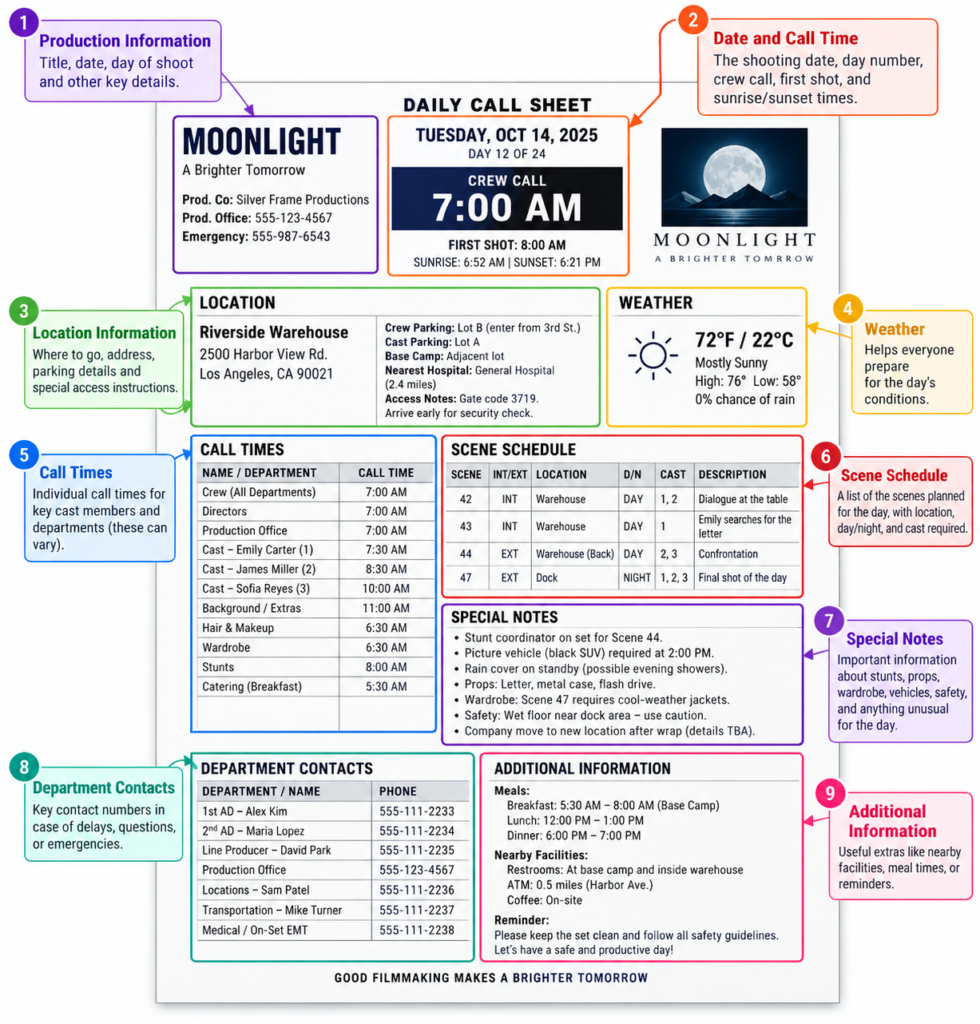
It is one of the most important communication documents on a film set.
From the actors’ call times and shooting location to the day’s scenes, parking instructions, weather, and special requirements, the call sheet brings together the practical information everyone needs before the cameras start rolling.
In this guide, we’ll look at what a call sheet is, what it contains, who creates it, how to read one, and why it is so important to film production.
A call sheet is a daily production document that provides cast and crew with the information they need for a specific shooting day.
It typically includes:
The call sheet is normally prepared by the assistant director (AD) department and distributed to cast and crew before the shooting day.
Put simply, the call sheet answers four essential questions:
Where do I need to be?
When do I need to be there?
What are we shooting?
What do I need to know before I arrive?
Film production involves a large number of people working together under tight time constraints.
Actors, directors, cinematographers, costume designers, makeup artists, sound technicians, production assistants, and dozens of other crew members may all have different responsibilities and different call times.
The call sheet gives everyone a shared plan for the day.
Without it, people would have to rely on separate messages, phone calls, emails, or verbal instructions. That creates opportunities for mistakes and misunderstandings.
A good call sheet allows everyone to prepare before arriving on set.
It can tell an actor when to arrive for makeup, tell a costume department which characters are needed, and tell the crew where to park and when the day’s work begins.
The call sheet doesn’t guarantee that the production will stay on schedule. Things inevitably change on a film set.
Its purpose is to make sure that everyone begins the day with the same information.
The exact design of a call sheet varies between productions, but most include several important sections.
The top of the call sheet usually identifies the production and the shooting day.
This may include:
This information makes it immediately clear which production day the document refers to.
The call sheet provides the location where filming will take place.
Depending on the production, it may include:
Location information is particularly important when the production is filming in an unfamiliar area or when parking and access are complicated.
One of the most important parts of a call sheet is the call time.
A call time is the time at which a particular person or department is expected to report for work.
There is often a general crew call, but individual people may have different call times.
For example:
| Person / Department | Call Time |
|---|---|
| Crew | 7:00 AM |
| Hair & Makeup | 7:15 AM |
| Actor A | 8:00 AM |
| Actor B | 9:00 AM |
| Background Actors | 10:00 AM |
An actor’s call time is therefore not necessarily the same as the crew call.
Actors may need to arrive later because their scenes are scheduled later in the day, or earlier because they require extensive hair, makeup, wardrobe, or special preparation.
Always check your individual call time rather than assuming everyone arrives at the same time.
A call sheet also provides an overview of the scenes planned for that day.
The schedule may list:
For example:
| Scene | Location | Time | Cast |
|---|---|---|---|
| 24 | INT. HOUSE – KITCHEN | DAY | 1, 3 |
| 25 | INT. HOUSE – HALLWAY | DAY | 1 |
| 26 | EXT. HOUSE | NIGHT | 1, 2, 4 |
This gives everyone a quick understanding of what the production intends to accomplish during the day.
The call sheet does not replace the script or the full shooting schedule. Instead, it gives the cast and crew a practical overview of the work planned for one specific day.
A call sheet may also contain notes about anything unusual or particularly important happening that day.
For example:
These notes allow the relevant departments to prepare in advance.
The assistant director department is generally responsible for preparing the call sheet.
On many productions, the Second Assistant Director (2nd AD) prepares the daily call sheet under the supervision of the First Assistant Director (1st AD).
However, the exact responsibilities can vary depending on the size and structure of the production.
Creating a call sheet requires information from many departments.
The AD department needs to know which scenes are scheduled, which actors are required, where the production will be filming, what special equipment or personnel are needed, and what logistical issues could affect the day.
The call sheet brings all of that information together into a single document.
The shooting schedule and the call sheet are closely connected, but they serve different purposes.
The shooting schedule is a broader production-planning document. It helps determine when and where the scenes in the script will be filmed throughout the production.
The call sheet focuses on one particular shooting day.
A simple way to remember the difference is:
Shooting schedule:
What are we shooting and when throughout the production?
Call sheet:
What do I need to know about tomorrow’s shoot?
The call sheet takes the production plan and turns it into practical information for the people who need to execute it.
A call sheet is generally distributed before the next shooting day.
The exact timing can vary between productions, but the goal is to give cast and crew enough time to read the information and prepare.
This is especially important when the next day’s work requires something unusual.
An actor may need to prepare a specific costume. A department may need to bring special equipment. A location may require additional access arrangements.
The call sheet is therefore part of the preparation for the shooting day—not simply a document people look at when they arrive.
If you’re a new actor or crew member, a call sheet can initially look overwhelming.
You don’t necessarily need to study every section equally. Start by finding the information that directly affects you.
Make sure you are looking at the call sheet for the correct shooting day.
Look for your individual call time or the call time for your department.
Don’t assume it is the same as the general crew call.
Confirm the exact filming location and read any parking, transportation, or access instructions.
Look at the scenes scheduled for the day and identify which ones involve you or your department.
Look for anything that could affect your preparation, including costumes, props, stunts, vehicles, animals, special effects, or safety instructions.
Know who to contact if you are delayed, cannot find the location, or have an important question before arriving.
A call time is the time a cast or crew member is expected to report for work.
Call times can vary from person to person.
For example, a camera operator may have a different call time from an actor, while an actor may have a separate call time for hair and makeup.
This is why the call sheet is so important: it tells each person when they are expected to be there, rather than simply providing one start time for the entire production.
The crew call is the scheduled time when the production crew is expected to report to the set or designated meeting location.
It is often earlier than the time when filming actually begins.
The crew may need time to unload equipment, prepare the set, complete lighting and camera setups, prepare costumes and makeup, and perform other tasks before the first shot.
For this reason:
Crew call ≠ first shot.
The call sheet helps everyone understand how much preparation time has been built into the shooting day.
A simple film call sheet might look something like this:
Production: The Last Night
Shooting Day: 12 of 24
Date: October 14
Crew Call: 7:00 AM
Location: 25 Example Street
Cast Calls
Scenes
Special Notes
This example illustrates the basic purpose of the document: to give everyone the information they need to get through that particular shooting day.
Another useful distinction is between the call sheet and other production documents.
A production may use several different schedules and reports, each serving a different purpose.
The call sheet primarily communicates the plan for the upcoming shooting day to cast and crew.
It focuses less on long-term planning and more on daily coordination.
A call sheet is only useful if the information on it is accurate and clear.
Common problems can include:
Even a small mistake can create problems for multiple departments.
For this reason, preparing the call sheet requires careful coordination between the AD department, production, locations, and other departments.
No.
The call sheet isn’t something you are expected to memorize. It is a reference document.
What matters is knowing the information relevant to you.
Before each shooting day, you should know:
Where you need to go.
When you need to arrive.
What you’re working on.
Who you need to report to.
Whether there are any special requirements.
Keep the call sheet accessible so you can check it if something changes during the day.
A call sheet may look like a simple production document, but it performs an essential function on a film set.
Film production depends on coordination. Hundreds of people may need to arrive at different times, prepare different things, move between locations, and work toward the same shooting plan.
The call sheet gives all of them a common reference point.
It tells cast and crew where to be, when to be there, what is being filmed, and what they need to know before the day begins.
It cannot prevent every problem on a film set. Schedules change, locations create unexpected problems, weather changes, and scenes take longer than expected.
But a good call sheet ensures that everyone starts with the same information.
And that makes it one of the most important practical tools in film production.