
Movie School Free » Film Directing Course » Film Cinematography for Directors » Arc Shot in Film
Arc Shot in Film: What It Is, How It Works, and How to Shoot One (With Examples)
An arc shot is a camera movement in which the camera travels along a curved path around a subject, keeping that subject in frame while the background shifts behind it. It is also called an orbit shot or, when it completes a full circle, a 360 shot.
Directors use the arc shot in film to add energy, heighten emotion, and make a moment feel important. This guide explains how an arc shot works, how it differs from a pan, how to shoot one with or without a dolly, and how filmmakers from Hitchcock to De Palma have used it.
Table of Contents
What Is an Arc Shot?
Arc Shot Definition
An arc shot is a shot in which the camera physically moves along a curved path around a subject. The subject stays roughly the same size and position in the frame, while the world behind and around them appears to rotate. The effect is smooth, dynamic, and slightly dramatic, which is why filmmakers save it for moments that matter.
The key word is moves. In an arc shot, the camera changes its position in space. This is what separates it from a pan, where the camera turns but stays in one place.
Partial Arc vs. Full 360° Circle
Arc shots come in different sizes:
- Partial arc: the camera travels through only part of a circle, often somewhere between 45° and 180°. This is the most common version. It adds energy without drawing too much attention to itself.
- Full circle (360°): the camera travels all the way around the subject and returns to where it started. This is bolder and more noticeable. It is also much harder to shoot, because the crew and equipment must stay out of the frame (see Common Problems below).
The larger the arc, the more the shot announces itself. A small arc can feel natural. A full circle almost always feels like a statement.
Other Names: Orbit Shot, Circular Tracking Shot, 360 Shot
You will see this camera movement described by several names:
- Orbit shot: the same movement, often used for drone footage, where the camera circles a landmark or a person.
- 360 shot or 360-degree shot: a full circle around the subject. (This is different from 360° video made for VR.)
- Circular tracking shot or camera arc: general descriptions of a camera tracking along a curve.
In practice, “arc shot” and “orbit shot” are usually used interchangeably, with “arc” suggesting a partial curve and “orbit” suggesting a more complete circle.
How an Arc Shot Works: Parallax Explained
The power of an arc shot comes from one visual principle: parallax. Parallax is the apparent shift in the position of objects when you look at them from different points of view. Anyone who has watched the scenery from a moving car has seen it. Nearby objects seem to rush past, while distant ones barely move.
Why the Background Changes While the Subject Stays Put
In an arc shot, the camera keeps the same distance from the subject while it moves around them. Because the distance does not change, the subject stays the same size and in the same place in the frame. But the camera’s viewpoint is constantly changing, so everything behind the subject appears to slide and rotate. A building that was on the left side of the frame slides behind the subject and then emerges on the right.
This is the core visual effect of the arc shot: the subject stays still in the frame, and the world moves around them.
How Parallax Creates Depth
The movement of the background relative to the foreground gives the viewer a strong sense of three-dimensional space. Objects at different distances shift at different speeds, so the image feels deeper and more real than a locked-off shot.
The effect is even stronger when the scene has layers, such as a person in the foreground, furniture in the middle, and a window or street in the background. A flat, empty background gives parallax very little to show, which is why arc shots look best in rich, layered environments.
Arc Shot vs. Pan: What Is the Difference?
In a pan, the camera stays in one spot and rotates on its axis. In an arc shot, the camera moves along a curved path through space. That single difference changes what the audience sees.
Think of it this way. If you stand still and turn your head to look around a room, that is a pan. If you walk in a circle around a statue while keeping your eyes on it, that is an arc.
A pan turns in place; an arc shot travels around the subject
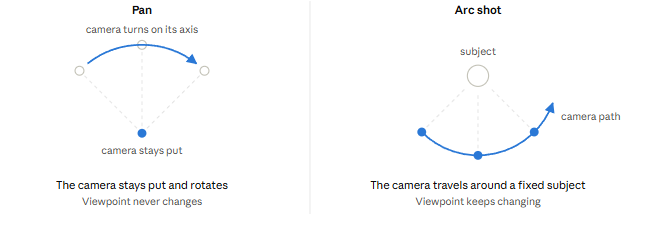
Seen from above, a pan keeps the camera in one spot while it turns. An arc shot sends the camera along a curve around the subject.
| Feature | Pan | Arc Shot |
|---|---|---|
| Camera Position | Fixed, rotating on its axis | Moving along a curve |
| What Happens to the Subject | Moves across the frame | Stays in place in the frame |
| What Happens to the Background | Slides past, with little change in perspective | Shifts with parallax, revealing new angles |
| Typical Purpose | Follow action or reveal a space | Emphasize a subject or a moment |
Seen from above, a pan keeps the camera in one spot while it turns. An arc shot sends the camera along a curve around the subject.
A pan changes where the camera is pointing. An arc shot changes where the camera is standing. This is why an arc shot feels more three-dimensional and more intimate: we see the subject from many angles, and the space around them reveals itself.
Arc Shot vs. Other Camera Movements
The arc shot is often confused with other camera movements. The table below shows how it compares.
| Movement | How the Camera Moves | What Happens to the Background | Typical Effect | Typical Use |
|---|---|---|---|---|
| Arc Shot | Travels along a curve around the subject | Rotates and shifts with parallax | Emphasis, energy, drama | Key emotional or dramatic moments |
| Pan | Rotates left or right on a fixed point | Slides past, no perspective change | Following or revealing | Following a character, scanning a scene |
| Tracking Shot | Travels alongside or behind the subject | Moves past in the same direction | Immersion, momentum | Walking and talking, chases |
| Dolly In / Out | Moves straight toward or away from the subject | Expands or contracts around the subject | Intensity or release | Moments of realization or distance |
| Crane Shot | Moves up, down, or through space on an arm | Changes scale and perspective | Scale, grandeur | Openings, endings, reveals |
These movements can be combined. An arc can include a slight move in or out, or a rise in height, which creates a spiral or a more complex path. These are often used in big, dramatic scenes.
Why Directors Use the Arc Shot
An arc shot is never just decoration. It works best when the movement matches what is happening emotionally or dramatically in the scene. These are the most common reasons directors choose it.
Emotion and Romance
Circling two people in an embrace or a kiss makes the rest of the world seem to fall away. The camera becomes a part of the moment, and the viewer feels its intensity. This is one of the most traditional uses of the arc shot.
Tension and Confrontation
When the camera circles characters in conflict, it can feel like a predator closing in or a pressure building. The movement turns a simple conversation or standoff into something more menacing, because there is no place to hide.
Power and the Hero Reveal
A slow arc around a character, often filmed from a low angle, makes them look larger than life. This is a staple of hero introductions and big moments of triumph.
Disorientation and Instability
A fast or unsteady arc can make the viewer feel dizzy or lost. It is often used for moments of shock, confusion, intoxication, or psychological pressure.
Intimacy: Two People, One World
In quiet scenes, a gentle arc around two characters can show a bond between them. The changing background shows time and place passing while their connection stays fixed.
Revealing Space
An arc can slowly uncover the surroundings of a character, showing where they are and what is around them. This helps establish the setting while keeping the focus on the person (see our guide to the establishing shot for more on this).
The common thread is that the arc shot keeps attention on the subject while changing everything around them. Use it when you want the audience to feel that a moment is bigger than the character’s surroundings.
How to Shoot an Arc Shot
There is no single way to shoot an arc shot. The right method depends on your budget, your location, and how smooth the movement needs to look.
Equipment Options
| Equipment | Advantage | Limitation | Relative Cost |
|---|---|---|---|
| Dolly on Curved Track | The smoothest and most controlled result | Needs setup time and space; the track can appear in wide shots | High |
| Steadicam or Gimbal | Flexible; fast to set up; works on uneven ground | Depends heavily on the operator’s skill | Medium |
| Handheld | Cheap and raw; good for tension | Shaky and hard to keep at a constant distance | Low |
| Crane or Jib | Lets you add height to the arc | Large, expensive, and needs a trained crew | High |
| Drone | Wide orbits around buildings, landscapes, and vehicles | Not suited to close interior shots; regulations apply | Medium |
| Turntable (Subject Rotates) | Simple and stable; good for products | The background does not change, so the effect differs | Low |
| Motion Control | Repeatable to the millimeter; ideal for effects and commercials | Specialized and expensive | Very High |
How to Shoot an Arc Shot Without a Dolly
You do not need a professional dolly to shoot a convincing arc shot. These options work on a small budget:
- A gimbal. Walk in a smooth curve around your subject, keeping your knees slightly bent and your steps small. Mark the path on the floor with tape.
- A wheelchair or office chair. Ask someone to push you slowly in a curve while you hold the camera. Rolling is far smoother than walking.
- A skateboard or camera slider on a table. For small subjects, a slider set in an arc gives a controlled movement.
- A rotating platform for a small subject. If the camera stays in place and the subject rotates, you get a similar feeling, though the background will not shift in the same way.
Rehearse the path before you shoot. A smooth arc depends more on planning than on gear.
Planning the Move
Before you shoot, decide on these elements:
- Radius: a small radius feels intimate and intense, while a large radius feels broader and more observational.
- Speed: a steady speed feels controlled and elegant. A changing speed adds tension or surprise.
- Direction: clockwise or counterclockwise. Choose the direction that fits the story and the background you want to reveal.
- Start and end frames: know exactly what the audience sees at the beginning and at the end. A good arc finishes on a frame that matters.
- Camera height: a low camera makes the subject look powerful, an eye-level camera feels natural, and a high camera can make the subject look vulnerable.
Focus and Lens Choice
Because the distance to the subject should stay constant, focus can often be set once. If the radius changes, a focus puller is needed. A wider lens exaggerates the sense of motion in the background and works well in tight spaces. A longer lens compresses the background and makes the movement feel calmer and more elegant.
Blocking the Actors Inside the Arc
The actors can move too. Plan their movement so it does not fight the camera. Often the best arc shots coordinate the actors’ timing with the camera, so that the most important line or gesture happens at the right point in the curve.
Common Problems and How to Solve Them
The 360° Blind Spot
The biggest challenge of a full-circle arc shot is that the camera sees everything around the subject, including the crew, the lights, the cables, and the microphones. There is nowhere to stand.
Common solutions:
- Light the scene from outside the set. Use practical lights that appear in the frame, such as lamps and windows, so that no stands are needed. See our guide to practical lighting for how this works.
- Hide the crew. Place the crew behind furniture, walls, or doors that the camera passes in front of, or have them move with the camera.
- Build the set with removable walls. Walls can be moved or opened as the camera passes.
- Fix it in post. Crew and equipment can be removed or painted out digitally, though this adds time and cost.
- Shoot a partial arc. If the story does not need a full circle, a smaller arc avoids the problem entirely.
Crossing the 180° Line
A full arc passes through every angle around the subject, including the opposite side of the line that editors normally avoid crossing. Because the shot is continuous, the audience watches the camera cross the line and keeps their orientation, so it usually works. The danger comes when you cut into or out of an arc at a point where the viewer has lost track of where the camera is. Plan your cuts so that the shot starts and ends on frames that connect clearly to the neighboring shots.
Sound, Continuity, and Cutting In and Out
A moving camera also moves the microphone, so plan where the boom operator will stand, or record dialogue with lavalier microphones. For continuity, make sure props and actors are in the same position at the end of each take. When editing, an arc shot often works best when it is allowed to play for its full length instead of being cut in the middle.
Arc Shot Examples in Famous Films
The best way to understand the arc shot is to see how filmmakers use it. Each example below includes a short frame breakdown to help you study the scene yourself.
Vertigo (1958): The Kiss That Changes the Room
In Alfred Hitchcock’s Vertigo, the camera circles Scottie and Judy as they kiss, and the room around them changes into a memory of the past. The arc does more than show the kiss: it shows what is happening inside Scottie’s mind.
- Type of arc: a full circle around the couple
- Effect: the changing background suggests memory, obsession, and the blurring of past and present
- Why it works: the subjects stay fixed while the world transforms around them
The De Palma Circle: Carrie (1976) and Blow Out (1981)
Brian De Palma is one of the filmmakers most closely associated with the circling camera. He often uses it to turn a moment of emotion or discovery into a piece of visual spectacle.
In Carrie, the camera circles the main character and her date as they dance at the prom. The movement captures the happiness of the moment, and its slow, dreamy feeling makes what follows more shocking.
In Blow Out, a circling camera follows the sound recordist as he works to match a recording to a series of images. The movement reflects his growing obsession and the way the truth is slowly closing in around him.
- Type of arc: circular moves around one or two characters
- Effect: romantic and dreamlike in Carrie, obsessive and tense in Blow Out
- Why it works: in both films the arc isolates the characters in a bubble of emotion, just before the story turns
The Matrix (1999): Bullet Time
The famous “bullet time” shots in The Matrix look like an arc shot frozen in time: the camera seems to circle a character as the action slows almost to a stop. The effect was created with an array of cameras placed around the actor and triggered in sequence, not with a single moving camera.
- Type of arc: a very wide arc, built from many still frames
- Effect: time slows down while the viewpoint keeps moving
- How it differs from a true arc shot: there is no single camera moving through space. It is an illusion of an arc shot, combined with slow motion. (More on this in the FAQ.)
The Avengers (2012): The Heroes Assemble
In the Battle of New York, the camera circles the whole team as they stand together for the first time. The arc gathers the characters into a single heroic image and shows that they are now fighting as one group.
- Type of arc: a full circle around a group, in the middle of action
- Effect: celebration and power; a “hero reveal” for a whole team
- Why it works: the viewer feels the energy of the group in a single continuous move
How to Study an Arc Shot
When you watch a film, pause during a circling shot and ask four questions:
- How far does the camera travel: a partial arc or a full circle?
- How does the background change, and does it add meaning?
- How fast is the movement, and does it speed up or slow down?
- What is the emotional state of the character at that moment, and how does the movement reflect it?
Common Mistakes to Avoid
- Using an arc shot for no reason. A circling camera draws attention to itself. If nothing in the scene justifies it, the audience notices the technique instead of the story.
- Uneven speed or shaky movement. Unless instability is the goal, a sudden speed change or wobble breaks the effect. Rehearse the path and mark it on the floor.
- Losing the subject. If the subject drifts out of the center of the frame, or goes out of focus, the shot loses its point. Keep the distance steady and check focus on every take.
- Overusing it. An arc shot is strongest when it is rare. Use it once or twice in a film for the moments that matter most.
- Shooting against an empty background. Parallax needs something to move. A bare wall gives the audience no sense of depth, so choose a setting with layers.
Try It Yourself
You can practice an arc shot with only a phone.
- Place an object, or ask a friend to stand still, in a room with a layered background such as furniture, a doorway, or a window.
- Mark a half circle on the floor with tape, about two meters from your subject.
- Walk the arc slowly while keeping the subject in the center of the frame, and record it.
- Repeat the shot while sitting on a rolling chair that a friend pushes along the same curve.
- Compare the two takes. Look at how smooth the movement is, and how the background shifts.
Try different radii, speeds, and camera heights, and notice how each one changes the feeling of the shot.
FAQ
What is an arc shot in film?
An arc shot is a camera movement in which the camera travels along a curved path around a subject while keeping the subject in frame. The background shifts as the camera moves, which adds depth and energy and emphasizes important moments.
What is the difference between an arc shot and a pan?
In a pan, the camera stays in one place and rotates on its axis. In an arc shot, the camera moves through space along a curve. A pan changes where the camera is pointing, while an arc shot changes where the camera is standing.
What is a 360 shot?
A 360 shot is an arc shot in which the camera travels a full circle around the subject and returns to its starting point. It is bolder than a partial arc and is harder to shoot, because the crew and equipment must stay out of the frame.
How do you shoot an arc shot without a dolly?
Use a gimbal or Steadicam and walk a smooth, marked curve around the subject. You can also sit on a rolling chair and have someone push you slowly along the path. Rehearse the movement first and keep the distance to the subject constant.
What equipment do you need for an arc shot?
The smoothest option is a dolly on curved track. A Steadicam or gimbal is more flexible, a crane or jib adds height, and a drone works for large outdoor orbits. A handheld camera can work too, with a less smooth result.
Is bullet time an arc shot?
Not exactly. Bullet time gives the impression of a camera circling a frozen or slowed moment, but it is usually created with many cameras placed around the subject, not with one camera moving along a path. It is a related technique that imitates the look of an arc shot.