
Movie School Free » Film Directing Course » Film Cinematography for Directors » What Is an Establishing Shot? Definition, Types, and Examples
What Is an Establishing Shot? Definition, Types, and Examples
What is an establishing shot? An establishing shot is a shot, usually wide or extreme wide, that shows the audience where and when a scene takes place before the action begins. It is a job a shot performs, not a specific shot size. Filmmakers use an establishing shot to set the location, time, mood, and scale of the story world, then cut closer to the characters.
Table of Contents
What is an establishing shot?
Establishing shot definition
An establishing shot is a shot placed at the start of a scene or sequence that gives the audience the context they need to understand what follows: the location, the time, and often the mood. It is typically a wide or extreme wide shot, such as the exterior of a building, an aerial view of a city, or a sweeping landscape. In most cases it is brief, carries no dialogue, and often contains no characters at all, only the setting.
An establishing shot is a role, not a shot type
This is the most common point of confusion. “Wide shot” describes how much is in the frame. “Establishing shot” describes what the shot does in the story. A wide shot becomes an establishing shot only when its job is to introduce a setting. The reverse is also true: a tight close-up of a street sign or a ringing alarm clock can establish place or time just as effectively, as long as it orients the audience.
The idea comes out of the continuity style of classical Hollywood filmmaking, which tends to move from a wide view of the space toward closer shots of the characters. The establishing shot is the widest step in that sequence. When the film later returns to a wide view in the middle of a scene to remind viewers of the geography, that is a re-establishing shot, explained in the FAQ below.
What does an establishing shot establish?
A good establishing shot does more than say “we are in Paris.” It delivers up to four kinds of information at once.
Place
Place is the basic function: a recognizable landmark, a type of architecture, a landscape, or a title card tells the audience where the scene is set. A skyline, a farmhouse and a spaceship corridor each place the story in a very different world.
Time
Time can be stated directly with on-screen text, or implied through light and detail: dawn fog, a night street with lit windows, snow on rooftops, period cars or period signage. The same building reads differently at noon than at 3 a.m.
Mood and tone
The way a place is photographed tells the audience how to feel about it before anyone speaks. A house shot from a low angle under storm clouds suggests threat. The same house shot in warm afternoon light suggests safety. Camera movement, music and sound design all contribute.
Scale and relationship between characters and world
A very wide shot can make a character look small against a landscape, a city or a machine, which tells the audience about power, isolation or ambition. The opening of Star Wars (1977) does this with a ship: a Star Destroyer glides into the frame overhead and keeps coming, and the small rebel ship it is chasing instantly feels outmatched.
Types of establishing shots
There are six common types of establishing shots. Most films and series mix several of them, and the best choice depends on what the scene needs to communicate.
Exterior building shot
An exterior building shot shows the outside of the place where the next scene happens: a police station, a family home, a hotel. It is the classic establishing shot of television. Sitcoms repeat the same exterior so the audience knows instantly that we are back in the familiar home base.
Aerial or drone shot
An aerial shot is filmed from a helicopter, plane or drone looking down on a city, landscape or building. It gives a sense of scale and geography that ground-level cameras cannot, and it has become far more accessible since drones replaced helicopters on many productions.
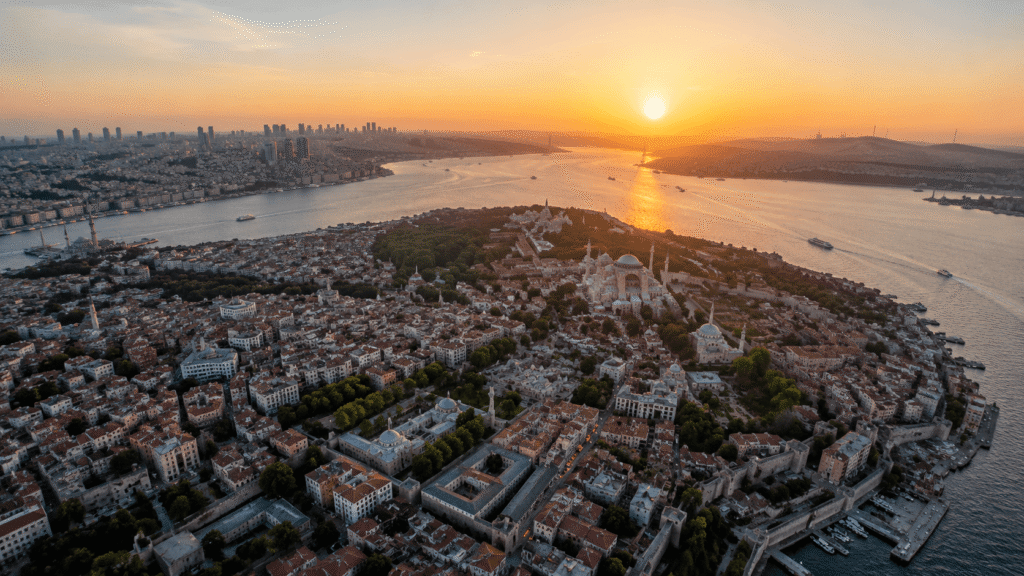
Landscape or cityscape panorama
A panorama shows a natural environment or a city from a fixed or distant viewpoint, often with a slow pan or a gentle push-in. It builds a sense of world rather than a single address: a desert, a harbor, a skyline at dusk.

Title-card establishing shot
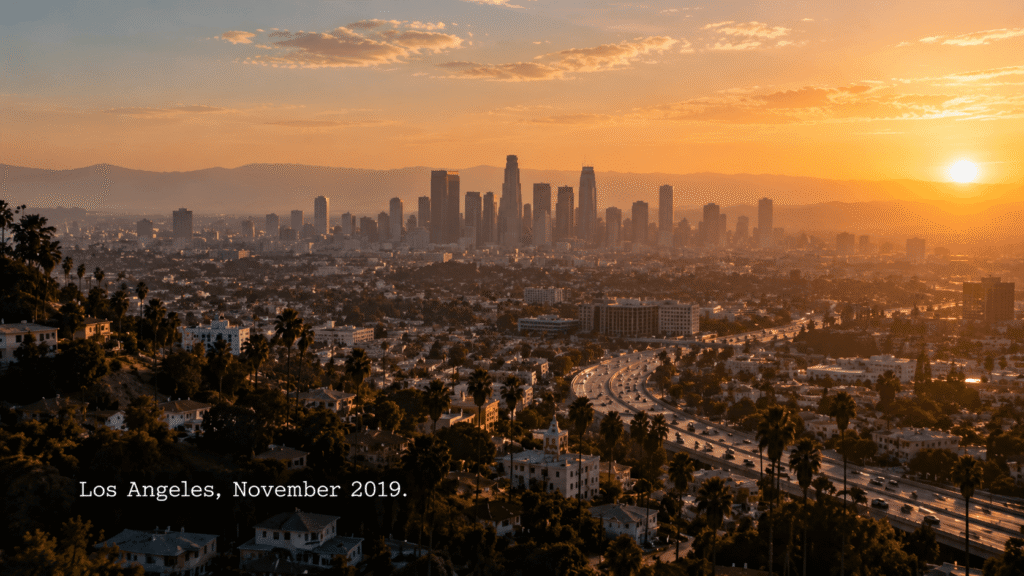
A title-card establishing shot combines an image with superimposed text that names the place and time, for example “Los Angeles, November 2019.” It is the fastest and most precise way to communicate information the picture cannot show on its own, such as an exact date or a city that looks like many others. The Godfather Part II uses it to introduce its Sicily flashbacks, pairing scenery with a title card.
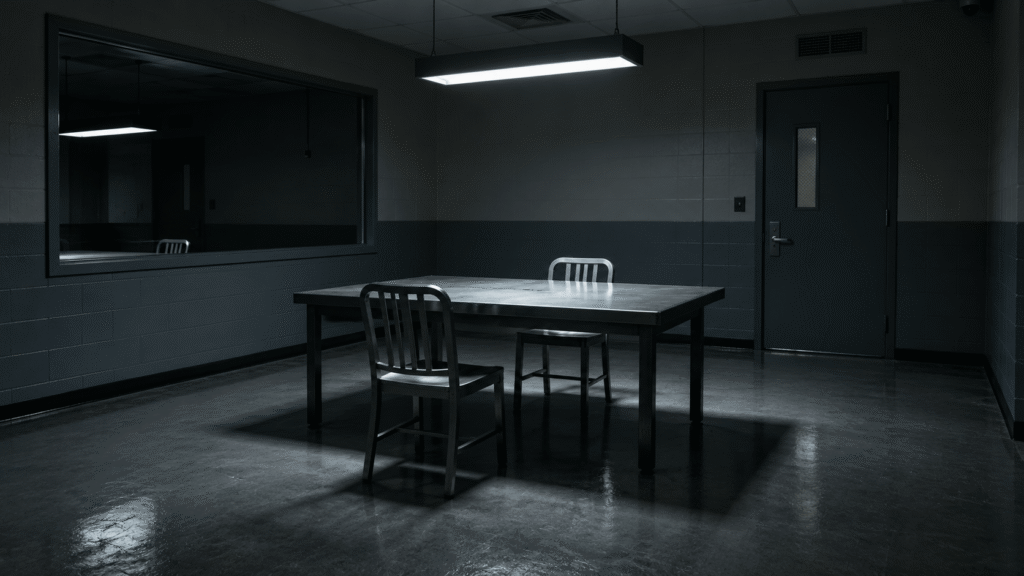
Interior establishing shot
An interior establishing shot is a wide view inside a space that defines it before the action starts: an empty interrogation room, a crowded classroom, the floor of a stock exchange. Interiors are easy to overlook, but they are often the establishing shots that matter most in small, dialogue-driven scenes.
Close-up or detail establishing shot
A close-up or detail establishing shot uses a small element to orient the audience instead of a wide view: a pencil taking notes to suggest a lecture hall, or rain hitting a window to set a gloomy mood. It works because the audience fills in the rest. See the FAQ for more on whether a close-up can be an establishing shot.

How to shoot an establishing shot
If you are wondering how to shoot an establishing shot, the process is simpler than most shots in a film, but each choice still affects what the audience understands. Work through these steps.
1. Decide what you need to establish
Start by deciding whether the scene needs to communicate place, time, mood, scale, or a combination. A generic city skyline is rarely enough on its own. Pairing a general view with a more specific shot, such as the particular building where the scene happens, tells the audience more.
2. Scout the location and choose the frame
Visit the location at the time of day you plan to shoot, ideally with your cinematographer, so the frame you planned is the frame you actually get. Strong establishing shots have a clear focal point and a sense of depth, with foreground, middle ground and background, so the eye knows where to go in the few seconds the shot is on screen.
3. Pick the shot size and lens
Most establishing shots are wide or extreme wide shots. Wide-angle lenses exaggerate depth and make spaces feel large and open. Longer lenses compress distance, stacking buildings or hills on top of each other and making a city feel dense or oppressive. See our guide to camera lenses for more on how focal length changes a shot.
4. Choose the camera movement
A static frame feels calm and observational. A slow pan reveals space gradually. A crane or drone move adds scale. A push-in toward a window, a door or a character is a classic way to transition from the wide view into the scene itself. Keep in mind that a moving camera implies a point of view, so ask whose eyes the audience is seeing through.
5. Plan the time of day and light
Because an establishing shot may be the first thing the audience sees of a location, light matters a great deal. Golden hour gives warmth, blue hour gives a cool, melancholy feel, and night shots with lit windows quickly signal that people are inside. Many productions shoot establishing shots separately, at the best light of the day, rather than during the main shoot.
6. Record sound
Sound does half the establishing. City traffic, birdsong, waves or an empty hum tell the audience about the space as much as the image does, and sound that carries over the cut helps glue the establishing shot to the scene that follows. If you fly a drone, remember that it is loud, so plan on replacing or building the sound in post.
7. Handle the practical side
- Permits and safety: filming exteriors and flying drones usually requires location permission and compliance with local aviation rules, which vary by country and by city.
- Second unit: because they rarely need the main actors, establishing shots are often filmed by a small second unit while the main crew shoots elsewhere.
- Stock footage: licensed stock is a common budget solution for cities that are too expensive or impractical to visit, as long as the style matches the rest of the film.
- Miniatures and visual effects: when a place does not exist or cannot be filmed, productions build scale models, paint backgrounds, or extend real locations digitally.
You do not need a large budget. A smartphone, a steady frame and good timing are enough to produce a convincing establishing shot for a short film.
Establishing shot examples with analysis
These establishing shot examples show how the same basic tool can create precision, dread, scale or style. For each one, notice what the shot shows, how it moves, and what it tells the audience before anyone speaks.
Psycho (1960): the aerial over Phoenix
What you see: After the title sequence, the camera glides over the rooftops of Phoenix, Arizona. Superimposed text gives the city, then the date and time down to the minute. The camera slowly closes in on a hotel window and slips inside through a gap beneath the half-drawn blind, arriving in a bedroom where two lovers are talking.
What it does: It establishes place and time with unusual precision, and the exact timestamp gives the story a cold, documentary feel. The approach is also voyeuristic: the camera is not simply showing a location, it is intruding on a private moment. It is also a transition, carrying us from the wide city into the intimate scene in a single continuous move.
The Shining (1980): the car on the mountain road
What you see: An extended aerial sequence follows a small yellow car along a winding mountain road beside a lake, filmed in and around Glacier National Park in Montana. The camera stays high, the landscape is vast, and the car looks tiny.
What it does: It establishes isolation before the story has begun. The audience is told, visually, that there is no help nearby and that the family is traveling into a place that dwarfs them, an effect strengthened by the ominous music. Later, exterior shots of the hotel itself use a real lodge, Timberline Lodge in Oregon, while the interiors were built on a studio set, a good reminder that a film’s “place” is often assembled from several locations.
Rear Window (1954): the courtyard as character
What you see: Bamboo blinds rise to reveal a courtyard surrounded by apartment buildings. The camera drifts out of the window, pans slowly across the neighbors’ windows and daily routines, and only then comes to rest on the sleeping main character, whose leg is in a cast.
What it does: This is an establishing shot for the entire film, not just one scene. It introduces the single location the story will almost never leave, and its slow survey plants the idea that this space contains many small stories. The courtyard itself was a huge, carefully built set on a studio soundstage, which let the director control every window.
Blade Runner (1982): world-building from above
What you see: A title card reads “Los Angeles, November 2019.” The film then shows an enormous nighttime cityscape: towering industrial structures, flames shooting from chimneys, and flying vehicles passing between giant buildings, with a close-up of an eye reflecting the view.
What it does: It establishes the setting, the year and a whole social atmosphere (crowded, polluted, hostile to nature) in one image. The shot was achieved with detailed miniatures and effects work rather than a real location, which is a perfect illustration of how filmmakers can establish a place that does not exist.
Beetlejuice (1988): the town that turns out to be a model
What you see: The film opens on a long shot that glides over an idyllic small New England town. For a moment it plays like a real aerial view. Then the scale gives it away: the whole town is a miniature, the model of Winter River, Connecticut, that Adam Maitland has built in the attic of his home.
What it does: It establishes the setting, a quiet, picture-perfect town, and introduces the main character through his hobby before he says a word. The reveal also sets the tone of the whole film: handmade, playful and deliberately artificial, in the spirit of the low-budget fantasy and horror movies director Tim Burton loved. It is an establishing shot that plays with the audience’s trust, because we believe we are looking at a real place until the film shows us otherwise.
Establishing shot for short-form video and YouTube
Do short videos need an establishing shot?
An establishing shot for short-form video and YouTube is a single quick frame, usually in the first one or two seconds, that tells viewers where the video takes place. Short formats do not leave room for a long reveal, but orientation still matters: viewers decide very quickly whether to keep watching, and a clear sense of place makes the rest of the video easier to follow.
A single fast frame with strong environmental cues can do the job without slowing the pace. A few practical ideas:
- Start wide, then cut in: open on the street, studio, trail or kitchen, then move to your subject.
- Add on-screen text for precision: a short location label does in a second what a long shot would take several to show.
- Frame for the platform: in vertical video, use height, such as buildings, trees, sky and foreground objects, to create depth in a narrow frame.
- Use an establishing shot for each new location: on YouTube, vloggers and educators often use one at the start of every chapter or location change.
- Let sound help: ambient audio carries information about the place even in a very short clip.
Subverting the establishing shot
Withholding context on purpose
Skipping the establishing shot is a deliberate choice that denies the audience orientation. The Godfather (1972) opens in black, then on a close-up of a man speaking, Bonasera, asking a favor. Only as the camera slowly pulls back do we see the listener, Don Corleone, and the dim office around them. The reveal of the space is delayed so that the audience concentrates on the words and the power dynamic before seeing the room.
Replacing the shot with on-screen text
Many modern productions skip the establishing shot to keep scenes moving and simply name the location in on-screen text, as the Law & Order franchise does. Mysteries sometimes avoid it too, because showing the setting clearly can reveal details the story wants to hide.
The misleading establishing shot
Some films use a conventional establishing shot to make the audience expect something, such as a quiet suburban home, then cut to a scene that contradicts it. Because audiences have learned to trust establishing shots as honest information, this trick works best when used sparingly. The opening of Beetlejuice, described in the examples above, plays a gentler version of the same game by passing off a miniature town as a real one.
Establishing shots with no plot function
As Ozu shows, an establishing-style shot can exist for rhythm and atmosphere rather than information. Used well, it lets a film slow down. Used badly, it is simply padding.
Common mistakes
Making the establishing shot too long
If the audience already understands the location, every extra second feels like a delay. Unless the shot is doing mood work, as in The Shining, cut as soon as the information has landed.
Repeating information that is already clear
If a character has just said “welcome to Rome” and the previous scene ended at the Colosseum, an additional establishing shot is redundant. Ask what new information the shot provides.
Using it automatically
A generic skyline at the start of every scene is a habit, not a choice. The best establishing shots are specific to the story: they show a detail only this film would show, from an angle that carries meaning.
Mismatched look
Stock footage or drone shots that do not match the film’s color, lens style or time of day pull the audience out of the story. Plan the look of establishing shots as carefully as the rest of the film.
Establishing shot vs master shot
An establishing shot and a master shot are often confused because both help the audience understand the space of a scene. The difference is scope: an establishing shot introduces the setting, while a master shot records the whole scene. The table below compares them side by side.
| Feature | Establishing shot | Master shot |
|---|---|---|
| Purpose | Tells the audience where and when the scene takes place | Covers the full action of the scene so the editor always has a complete version to cut from |
| What it shows | The setting: a building, landscape, city or room | The characters and their movements within the space, from start to finish |
| Typical length | A few seconds, often under five | The full length of the scene, sometimes minutes |
| Characters and dialogue | Usually no dialogue and often no characters | All relevant characters performing the scene, including dialogue |
| Typical shot size | Wide or extreme wide | Wide to medium-wide, wide enough for all the action to play |
| Position in the scene | At the start, to orient the audience | Runs through the whole scene and serves as the backbone of the coverage |
| Can it do the other's job? | No. It does not cover the scene's action, so it cannot work as a master shot | Yes. If its opening framing sets the location, it can be cut short and used as an establishing shot |
| How it is usually shot | Often by a second unit, or bought as stock footage | With the main cast, usually as the first setup of the scene |