
Last updated on: November 4th, 2026
Movie School Free » Documentary Filmmaking Course » How to Structure a Documentary Narrative
How to Structure a Documentary Narrative: Storytelling Rules, Common Structures, and Editing Tips
Structuring a documentary means deciding what story your material tells, in what order, and why, so viewers stay curious from the first minute to the last. Unlike a scripted film, a documentary’s structure is rarely fixed in advance. It is built and rebuilt in the edit, using the footage you actually have.
This guide shows how to structure a documentary: the storytelling rules that matter, how to hook the viewer from the start, the most common documentary narrative structures, and a step-by-step process for restructuring until the story truly works. If you are still looking for the story itself, start with our guide to Finding Your Story Within the Subject. This article picks up from there and shows how to build that story into a film.
Table of Contents
Why Structure Matters in Documentary
Every documentary starts with raw material: interviews, observational footage, archive, photographs, and whatever happened in front of the camera. That material is not yet a story. Structure is what turns it into one.
A Subject Is Not a Story
A subject is what your film is about: a town, a profession, a disease, a historical event. A story is what happens within that subject: someone wants something, something stands in the way, and something changes. Many documentaries struggle because they have a subject but no story, and the footage is organized by topic instead of by tension.
This is the difference between a documentary narrative structure and a simple collection of scenes. A topic can be explained in any order. A story has to unfold in a particular order, because each part changes what the viewer expects from the next.
Without Structure, You Have Moments. With It, You Have Momentum
A pile of strong moments does not carry an audience for ninety minutes, or even for ten. Structure creates questions, expectation, and progression. It decides when the viewer learns something, when they start to worry, and when they get an answer. Good documentary story structure feels invisible to the viewer, but it is the reason they keep watching.
Choosing and Ordering Is the Filmmaker’s Job
A documentary filmmaker does not invent facts, but they do choose which facts to include, which to leave out, and in what order to present them. Those choices are the heart of the craft. They are also a responsibility, which we return to in the section on ethics below.
Storytelling Rules That Apply to Documentary
The principles of good storytelling are the same in fiction and nonfiction. The difference is that in a documentary you cannot write them in. You have to find them in the material and bring them forward in the edit. These are the rules that matter most for documentary storytelling.
1. Give the Audience Someone to Follow
Stories are driven by people who want something and face an obstacle. In a documentary, this can be a main character, a group, or even an investigator trying to answer a question. Without a clear want, the audience has nothing to root for or worry about.
2. Raise a Dramatic Question
A dramatic question is what keeps viewers watching: Will she succeed? What really happened? Why is this happening? In a documentary, the question can be personal, mysterious, or social, but it must be clear early and remain open for a while. When the question is answered, the film is over.
3. Link Scenes by Cause and Effect
A weak structure moves from scene to scene with “and then.” A strong one moves with “therefore” and “but.” Each scene should follow from the one before it, either because of it or in spite of it. This is also how you test your edit: if you can remove a scene and nothing changes, it probably does not belong.
4. Show What Is at Stake
The audience needs to understand what could be gained or lost. Stakes do not have to be life and death. A personal dream, a community’s future, or a reputation can all work, as long as the viewer knows what hangs in the balance.
5. Build Toward Change
Something should be different at the end than at the beginning: a person, a situation, or the audience’s understanding. Even observational films that appear to have no plot usually have a quiet change that gives them shape.
6. Release Information Gradually
Do not explain everything at once. Give the viewer enough to be curious, then reveal more as the story moves forward. Good documentary storytelling treats information as something to be earned, not delivered in the first five minutes.
These ideas connect to broader story models. For a deeper look at how acts and turning points work, see our guide to the five-act structure.
How to Start a Documentary: Grab the Viewer From the First Minute
The opening of a documentary is a promise. In the first minutes, the audience decides whether this film is worth their time, and the choices you make there shape how they read everything that follows. If you are wondering how to start a documentary, the goal is simple: raise a question the viewer wants answered.
What a Strong Opening Does
A strong opening does three things at once:
- It creates curiosity. The viewer wants to know what happens next, or why.
- It makes a promise. It signals the kind of experience the film offers: a mystery, an intimate portrait, an investigation, a journey.
- It introduces the stakes. Even without explaining everything, it hints at what could be gained or lost.
Opening Techniques That Work
- The cold open. Start with a striking moment, often from later in the story, before any titles or background. It gives the audience a reason to care before you explain anything.
- An open question. Begin with a mystery or contradiction that the rest of the film will explore.
- A character in a charged moment. Introduce someone in the middle of a decision, a problem, or a risk, rather than describing them from a distance.
- A striking contrast. Put two things next to each other that do not fit, and let the gap create tension.
- A moment from the climax. Show a brief glimpse of the most intense part of the story, then return to the beginning and build toward it. This promises the audience a payoff.
For more on how the first images of a film set expectations, see our guide to the opening image vs. the opening shot.
What to Avoid
- Long historical background up front. Context matters, but it is easier to absorb once the viewer is invested.
- A talking head explaining the whole topic. Information without a question rarely holds attention.
- A generic montage of landscapes, faces, or archive with music, but no question or character. It sets a mood without making a promise.
- An opening that does not match the film. If the first minutes suggest a thriller and the rest is a quiet portrait, viewers feel misled.
Test Your Opening
Ask three questions of your first two minutes: What question has been raised? Who or what should the viewer care about? What do they expect the film to be? If you cannot answer all three, the structure is not working yet.
Common Documentary Structures
There is no single correct documentary narrative structure. Different stories and different material call for different shapes. The table below compares the most common ones.
| Structure | How It Works | Best For | Main Risk |
|---|---|---|---|
| Chronological | Events are told in the order they happened. | Biographies, historical events, clear cause-and-effect stories. | Can feel flat if nothing builds. |
| Three-act | Setup, confrontation, resolution. | Stories with a clear problem and outcome. | Real events may not fit a neat climax. |
| Five-act | Exposition, rising action, climax, falling action, resolution. | Longer, layered stories with several turning points. | Can feel forced if applied rigidly. |
| Investigation / Mystery | A question drives the film, and answers are revealed in stages. | True crime, journalism, hidden histories. | Withholding information can feel manipulative. |
| Character-driven Journey | We follow a person through a challenge or change. | Portraits, sports, personal transformation. | Depends on a compelling person and access. |
| Thematic / Chapters | Sections explore different aspects of a topic. | Essays, explainers, wide subjects. | Can lack momentum between chapters. |
| Braided / Parallel | Two or more storylines are cut together and echo each other. | Stories with contrasting perspectives or time frames. | The threads must connect, or the audience loses track. |
| Observational (Verité) | Events are followed as they unfold, with little narration. | Ongoing situations, access-based films. | The structure is found late, in the edit. |
The Documentary Three-Act Structure
The documentary three-act structure borrows the shape of a scripted film:
- Act One (setup): introduce the world, the main character or question, and the problem that sets the story in motion.
- Act Two (confrontation): complications, setbacks, and rising pressure as the main character or investigation tries to move forward.
- Act Three (resolution): the climax and its consequences, and a sense of what has changed.
It is a useful starting frame, but real life rarely follows it exactly. Documentaries often have to adapt the model: the climax may be quiet, the resolution may be uncertain, and the question may remain partly open. Treat the three-act structure as a tool for testing your edit, not a template to force your material into. For a more detailed model, see our guide to the five-act structure.
How to Choose
Start by asking what drives your story: a person, a question, or a theme. A character-driven story usually suggests a journey structure. A question suggests an investigation. A broad topic with no single protagonist often suggests chapters. In practice, many strong documentaries combine two or more structures, and the right choice often becomes clear only after you try one.
Restructure Until It Works
This is the most important idea in the article: a documentary’s structure is not found once. It is tested, broken, and rebuilt, over and over, until something actually works.
Your First Structure Is Rarely the Right One
In a scripted film, the structure is planned on the page. In a documentary, the material surprises you. Interviews go in unexpected directions, the person you thought was the main character turns out not to be, and the real story may differ from the one you set out to tell. A structure that looked perfect on paper often falls apart the first time you watch it in the timeline.
That is not a failure. It is how documentary editing works. The filmmakers who end up with the strongest films are usually the ones who are willing to change the structure, even radically, many times.
How to Structure a Documentary Without a Script
Most documentaries are structured without a traditional script. Instead, you build the structure through a repeating process:
- Log your footage. Watch everything, transcribe interviews, and tag moments by theme, character, emotion, and importance. You cannot structure what you do not know you have.
- Write a logline and a central question. Put the story in one or two sentences and name the question the film is trying to answer. This is your compass for every decision that follows.
- Build a paper edit. Put the key scenes, quotes, and moments on index cards, sticky notes, or a digital board. Arrange them into a possible order, and rearrange them freely. This is the cheapest way to try a structure, because moving a card costs nothing.
- Cut a rough assembly. Turn the best version of the paper edit into a first, rough cut. It will be too long and imperfect. Its job is to show you the shape of the film.
- Watch and diagnose. Watch the assembly as if you had never seen the material. Note where you lose interest, where you are confused, and where you want more.
- Restructure, and mean it. Make a significant change, not just a trim. Then watch again.
- Repeat until the story holds together from beginning to end.
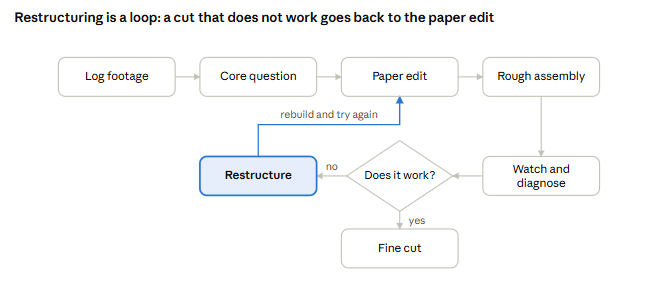
Each pass ends with a test. If the cut does not work, you make a big structural change and rebuild from the paper edit.
Ways to Restructure
When a structure is not working, try changing something big, not something small. For example:
- Start somewhere else. Open with the ending, the turning point, or a different character.
- Move the climax. Place the most intense moment earlier or later and see how the rest reacts.
- Change whose story it is. Shift the main perspective to another person or to the question itself.
- Change the type of structure. Convert a chronological film into an investigation, or a set of chapters into a single journey.
- Cut a character or a thread. If a storyline does not push the main question forward, removing it often makes the film clearer.
- Reorder by emotion, not by time. Group scenes by what the audience feels instead of when the events happened.
Questions That Help You Diagnose a Cut
- Where did I get bored, and what was happening in the story at that point?
- At what point did I forget what the film was asking?
- Which scene could I remove without anyone noticing?
- Do I understand what the main character wants by the end of the first act?
- Does the ending answer the question the opening raised?
Test With Fresh Eyes
After weeks with the same footage, you can no longer see it clearly. Show a cut to someone who knows nothing about the project, and watch them rather than asking for opinions. Notice when they look away, check their phone, or ask a question out loud. Those moments show you where the structure is breaking, even when they cannot explain why.
Let Go of What You Love
Some of the best material will not fit the best structure. A beautiful scene that does not move the story forward belongs in the outtakes, not the film. This is among the hardest parts of editing a documentary and among the most important.
Change With Purpose
Restructuring is not random shuffling. Before each change, ask what you want the viewer to feel and understand at that moment, and what the structure is currently doing instead. Every new version should answer a specific problem. When the central question is clear, the first minutes grab the viewer, each scene leads to the next, and the ending pays off the opening, you are close to a structure that works.
Structure and Ethics
A documentary promises the audience that what they see is true, so structural choices carry ethical weight. Reordering events, placing an interview answer next to a different question, or combining moments from different days can change what a viewer understands, even if every shot is real.
Some practical guidelines:
- Keep the context of what people said. A quote cut to fit your structure should still mean what the speaker intended.
- Be open about reconstructions and non-linear time. If you use recreations or jump between periods, make that clear to the viewer.
- Check your facts before you lock the structure. A structure built on a wrong detail has to be rebuilt later.
Structure is a form of interpretation, and good documentarians stay honest about that.
Common Mistakes to Avoid
- Falling in love with the subject instead of the story. Fascinating material is not the same as a film. Keep asking what the story is.
- Hiding the central question. If the audience cannot tell what the film is asking, they lose their reason to watch.
- Too many characters. Each new person needs time to become real. Follow fewer people more deeply.
- An ending that ignores the opening. The film should answer, or knowingly complicate, the question it raised at the start.
- Organizing by topic instead of by tension. A well-sorted list of ideas is not yet a story.
- Leaving structure until the edit is nearly over. Think about possible shapes while you shoot, so you capture the scenes, reactions, and context you will need. Waiting until the end can leave gaps that cannot be filled.
- Refusing to change the structure. If a version does not work after several tries, a bigger change is usually needed, not a smaller tweak.
FAQ
What is the best structure for a documentary?
There is no single best structure. Chronological, three-act, investigation, character-driven journey, and chapter-based structures all work, depending on your story. The best structure is the one that keeps the central question clear and the audience curious, and it is usually found by testing several versions in the edit.
How do you start a documentary?
Start with a moment, question, or character that makes viewers curious. Common choices are a cold open, an unresolved question, a character in a charged moment, or a glimpse of the climax. Avoid long background explanations and generic montages in the first minutes.
Do documentaries need a three-act structure?
No, but many use one because it is a clear way to organize setup, complication, and resolution. Documentaries often adapt the model, since real events do not always produce a neat climax. Treat the documentary three-act structure as a tool for testing your edit, not a rule.
How do you structure a documentary without a script?
Log your footage, write a logline and central question, build a paper edit with cards or notes, cut a rough assembly, then watch, diagnose, and restructure. Repeat the cycle until the story holds together from start to finish.
Can you change the structure in the edit?
Yes. In documentary filmmaking the edit is where the structure is built, and major restructuring is normal. Many films take their final shape only after several very different versions have been tried.