
Movie School Free » Film Directing Course » Film Cinematography for Directors » Camera Shots
Essential Types of Movie Shots and Camera Angles
Want to become a filmmaker? whether you aiming to be a sound technician, cinematographer, or director, mastering the types of shots is non-negotiable. Understanding how to use the different types of shots is the foundation of cinematic language – it’s how directors, DPs, and crew members communicate visually on set. Whether you’re shooting a high-concept narrative or a raw documentary, knowing the types of movie shots gives you the power to shape your viewers’ emotional experience.
Table of Contents
In this guide to the different types of shots (also called types of movie shots), you’ll learn how types of shots in movies – from extreme wide shots to close-ups- can dramatically alter viewer perception.
In film, every framing choice speaks volumes. Imagine a camera panning slowly across a room and suddenly stopping on an object—instantly, the audience senses that this object holds meaning. Or consider a slow pan between two characters in conversation—it can heighten tension or highlight contrast without a single word spoken. These different kinds of shots don’t just show—they tell. The types of shots in movies you choose will directly influence how your audience perceives the scene, the characters, and even the story itself.
Why knowing the basic types of shots names is important?
I know I promised that on this blog, I want to focus more on the creative part of filmmaking than the technical part, but knowing the camera angles and shots is very basic and will help us to communicate better on the next articles.
The camera angles and shots are the basic language of film production. Everybody in the production set will communicate using a shooting script that will include these shots names, so you absolutely must know them. The camera angles are the best tool to tell a story without explaining too much.
How Different Types of Shots Affect Your Storytelling?
The camera angles you’ll choose will be a great tool to describe the relationships of the characters without words. POV shot (I will explain it later on) will tell the audience who is the important character in the scene (that will also be the character that gets more screen time) If you’ll shoot one character closer and the other in a more open shot, the one that was shot closer will look and feel to the audience as the stronger one. Read the next shots, angels, I’m introducing here and you will understand what I’m saying.
so here it goes:
The Different Types of Shots
Long Shot(LS )
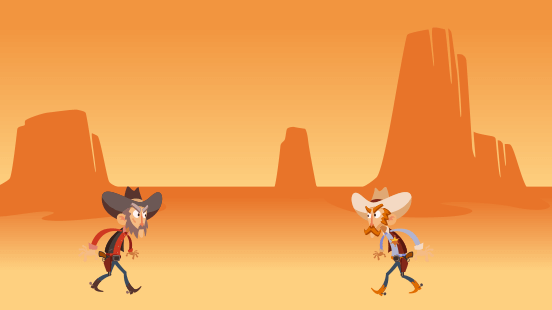
Also called Wide shot. That type of shot shows all the body of the photographed object and some of its background. Usually, we use it the beginning of a scene, so the audience will understand where the scene is taking place. Sometimes, when the scene is long,
we will use it to remind the audience where the scene is happening. This angle has no emotional strength. It simply gives us information.
Medium Shot(MS)
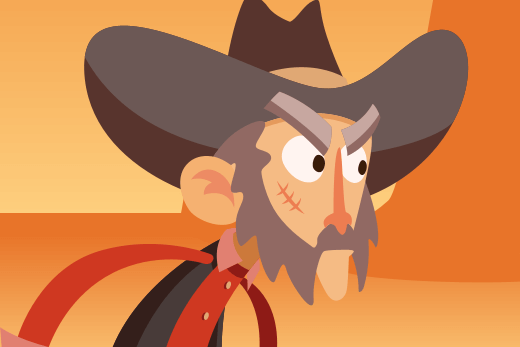
A very popular type of shot angle. Also called “Waist shot”. Usually, it’s an angle that contains the top of the photographed object. It creates a sense of distance from the person that is being shot, but to such an extent that we can still see him and his body language clearly, with some level of intimacy. When you are using this kind of shot (and you are going to use it a lot), you must pay attention to the background. Also pay attention to the actor’s body posture and movements.
Two Shot
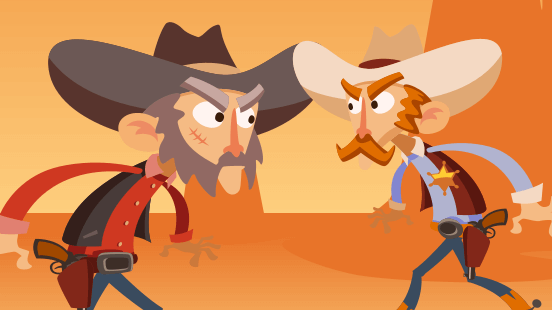
The same as Medium Shot with the difference that it includes two people. In this example we see the two characters facing each other, but it doesn’t have to be like that. You could also have a two-shot where on the character is in the front and the other is in the back. This shot is good to deliver the emotions that are running between the two characters.
Medium Close Up (MCU )
A very intimate shot. We see is only head and shoulders. This shot is used a lot in interviews and TV. In films we use MCU a lot on reaction shots or when we want to emphasize the drama.It is customary to put the photographed object in this shot just beyond the center of the frame, so the shot will not be too symmetrical. You should also leave a space on the side to which the character speaks or turns to. The Close Up shot is similar but a little closer.
The advantages of Medium shots are:
- They are easy to lighten and it’s also easy to connect them with other shots in the scene.
- This shot helps to convey what the character feels with only very light expressions using mainly the eyes.
The disadvantages of Medium shots are:
- Sometimes the shot has nothing to do with the spirit of the scene and can serve as a kind of invasion of subject’s privacy (especially in documentary cinema). The viewer may find himself uncomfortable when it happens.
Close-Up/Extreme Close-Up (ECU)
Close-up is a shot that turns the object that is beeing shot to very important one in the frame. In ECU the shot is very close to the object. For example, in a person shot, we might see only the face of the character or only his hands. The feeling that the viewer gets is that what we see at the moment is very important, or with intense emotional weight. For example, a woman walking on the street at night. ECU on her eyes can convey to us a sense that she is scared.
Over The Shoulder Shot (O/S)
The shot focuses on an object over the shoulder of another person whose face is directed to the same object. We will see the back of the shoulder and part of the head of the person who looks at the object. Directors use this shot a lot in dialogues since it is kind of a “shortcut” to see both characters at the same time.

Point of view (POV)
The POV shot is a great film technique to make the viewer identify with your character. This is also a great way to create tense. In the POV shot, the camera transmits the point of view of an object in the scene. It basically takes the place of character that looks at something. If we are filming two people talking and we want to pass the point of view of one over the other,
the camera will be in front of the photographed object in the place of the one we want to emulate his eyes. Usually, the photographed object will not look directly into the camera, but 30 degrees to the side. If the object looks directly into the camera, it’s like he is looking directly at the audience and thus breaks the magic of cinema. Of course, there are quite a few films that do this on purpose, but this should be a conscious decision.
low-angle shot
On this shot, the camera is positioned at a low angle, anywhere below the eye line as if it’s looking up. This type of shot is making the object look very big, strong, and powerful. Sometimes this shot can be used to make the audience feel close to the action.

High Angle Shot
On this shot the camera is positioned on a high angle, making the object look small. Directors use this shot to make their characters look weak. It is also good to bring an overview of the scene from an unexpected angle.
So there are many more types of camera shots and angles, but I think I brought the important ones here. If you think I missed any important camera shots,
let me know
More camera shots and terms you need to know
Establishing Shot
An establishing shot is the shot used to open a scene and show the audience where the action is taking place. It’s usually a wide or long shot, but it can also be an aerial or crane shot if the location itself deserves extra scale. Think of the classic movie opening: an establishing shot of a city skyline before cutting down to a single window, then to the character inside it. It’s less about a specific frame size and more about the job the shot is doing in the story setting the scene before anything else happens.
Crane Shot
A crane shot is filmed using a camera mounted on a mechanical crane, letting the camera move smoothly through vertical space, rising above the action, sweeping down toward it, or gliding over obstacles a handheld or tripod shot never could. Directors often use it to reveal scale, for example rising from a character’s face up to reveal an entire crowd behind them, or to glide gracefully from one scene into the next.
Bird’s-Eye View Shot
A bird’s-eye view shot is filmed from directly above the scene, looking straight down, as if seen from a bird flying overhead. Unlike a regular high-angle shot, which is angled downward, a bird’s-eye view is perfectly vertical. It flattens the action and makes characters look small, which is useful for showing patterns, choreography, or how insignificant a character feels within a larger space.
Aerial Shot
An aerial shot is a wide shot filmed from an aircraft, helicopter, or drone, showing a large area of landscape or cityscape from above. It’s often used as an establishing shot for its sense of scale. However, it doesn’t have to be perfectly vertical like a bird’s-eye view; an aerial shot can be angled to reveal geography, follow a moving vehicle, or simply give the audience a sense of scope.
Dutch Angle
Also called a Dutch tilt or canted angle, this is a shot where the camera is deliberately tilted off its horizontal axis, so the horizon line sits diagonally in the frame instead of level. It’s one of the most recognizable ways to create a feeling of unease, disorientation, or psychological instability without a single line of dialogue the character’s world is literally tipping off balance.
Deep Focus
Deep focus is a shot where everything in the frame foreground, midground, and background stays in sharp focus at the same time. It requires a small aperture and careful lighting, and it lets a director stage action on multiple planes at once, giving the audience the freedom to choose where to look instead of being told by focus alone.
The advantages of deep focus are:
- It lets a director block complex scenes across multiple depths without needing to cut.
- It gives the audience visual freedom to explore the whole frame.
The disadvantages of deep focus are:
- It requires more light and smaller apertures, which can be technically demanding.
- It can dilute the emotional focus of a scene if used carelessly.
Shallow Focus
Shallow focus is the opposite of deep focus: a shot where only one plane of the image is in sharp focus while everything in front of and behind it blurs into a soft background. It’s one of the most common tools for directing an audience’s eye straight to a character’s face or a specific object, isolating them from a distracting background.
Cutaway Shot
A cutaway shot is a brief shot that moves away from the main action of a scene — a reaction shot, a close-up on a clock, a glance at a phone before cutting back to where it left off. It’s as much an editing technique as a shooting one, since a well-placed cutaway can hide a continuity mistake, compress time, or add emotional emphasis without breaking the scene’s flow.
Reverse Shot
A reverse shot is filmed from the opposite direction of the previous shot, usually used in dialogue scenes to alternate between two characters facing each other. Paired with an over-the-shoulder shot, a sequence of shot/reverse-shot is the standard grammar for filming a conversation, letting the audience feel like they’re inside the exchange rather than just watching it from the outside.
One Shot
A one-shot, sometimes just called a “single,” frames exactly one subject alone, with no other characters present. It’s the natural counterpart to the two shot used when a director wants the audience’s full attention on a single character’s reaction, decision, or isolation within a scene.
Bridging Shot
A bridging shot is used to connect two scenes, or to indicate a passage of time or a change of place, without cutting abruptly between them. Classic examples include a calendar’s pages flipping, a train moving across a map, or a clock’s hands spinning forward. It’s used less often in modern films; a hard cut or a simple caption often does the same job now, but it’s still a useful tool when a story needs to bridge a longer gap smoothly.